“A big part of the job is building rapport”. That line, spoken by Louis Theroux, flickered across my screen in subtitles last night, glowing in the quiet of the living room. He wasn’t talking about therapy, or parenting, or politics. He was talking about his own curious profession — stepping into the lives of strangers and trying to understand them. But it struck me as something much bigger than his job. It struck me as something closer to a way of life.
Theroux goes on: “if you go in as a sympathetic presence, or at least listening and paying attention, people for the most part are happy to open up and feel grateful for you being there.”
There’s something quietly radical about that. In a world where we’re often taught to perform, persuade, or posture — to win arguments, get results, hit targets — he suggests the opposite. Go in gently. Listen without the pressure to fix. Pay attention without needing to steer the story. Offer presence instead of solutions. The reward? People feel seen. People open up.
I think we forget how powerful that is.
I’ve seen it with loved ones who are grieving and don’t need advice, just company. I’ve seen it with new parents who aren’t asking for judgment, only recognition. I’ve seen it in work meetings where the most impactful thing isn’t a killer idea but a moment of shared honesty which enhanced a relationship. I’ve felt it in myself — how much lighter I become when someone is simply with me, not trying to solve a complaint.
Theroux’s approach is a reminder that people are not puzzles to be cracked or problems to be psychoanalysed. Most of us are just hoping for someone to really hear us. To sit with us without rushing to fill the silence. To ask questions not as a form of interrogation, but as an invitation to be known.
This isn’t just about interviewing people on camera. It’s about how we show up in our lives. Whether we’re leading a team, raising a child, comforting a friend, or navigating the everyday mess of being human — the same truth applies: building rapport, connection, trust — that’s the real work. That’s the foundation everything else rests on.
And yes, it won’t always work. Sometimes people won’t respond. Sometimes we’ll be met with resistance, with closed doors, with the limits of what we can reach. But even then, we’ll know we showed up as a sympathetic presence. We listened. We paid attention. We offered something quiet but rare.
And in a world that often rewards the loudest voice, maybe the most radical thing we can do… is simply to be there and be human.
In a world that feels like it’s permanently spinning just a bit too fast, the smallest routines can feel like sacred acts.
I’m talking about the coffee you make for your partner each morning, half-asleep but still reaching for the coffee pods before they’ve opened their eyes. The pint with your dad in the same corner of the same pub, before kickoff. The walk with your colleague at lunch, tracing the same stretch of the Thames no matter the weather.
They’re not big. They’re not revolutionary. But they matter.
Because the world today is chaos dressed up as convenience. Everything’s available. Nothing’s grounded. Our attention is a currency we’re spending recklessly on things that do not give a single shit about us. The algorithm doesn’t care if you’re lonely. The endless scroll won’t hold your hand when life cracks open.
And yet we let it in, constantly. Like moths to the light.
So these tiny rituals? They’re rebellion. They’re resistance. They’re deeply, quietly human.
If you rewind just a few decades—before the avalanche of content, before phones became appendages—life was defined by routine. You knew the rhythm. Friday: Top Of The Pops with fish and chips. Saturday: football. Sunday: roast then The Simpsons. Monday: EastEnders at 8PM. You weren’t just surviving. You were participating in a kind of secular liturgy with millions of Brits. You belonged to something, even if it was just a pattern. And that had weight. It had meaning.
Now? Everything’s a blur. Every app wants to be your new home. Every platform wants to colonise your time. And in all of that noise, it’s these small, self-defined moments of routine that whisper: you’re still here. You’re still a person.
I’m not writing this to help you. I’m writing this because I had to. I needed to say it out loud. Maybe because I’m trying to remind myself, too.
Forge your own rhythm. Mark out your own minutes in the day that no one can steal from you. They don’t have to be profound. They just have to be yours and you have to turn up for them.
“You wouldn’t understand — you don’t have children.”
It always felt like the highest form of condescension. Dismissive. Wounding. As though empathy was something you either earned through parenthood or didn’t possess at all. As if my experiences, my capacity to care, or my exhaustion didn’t count.
Worse still, it ignored something deeper: that not everyone without children chose that. That for many, it’s a source of grief, not a lifestyle. And so that phrase, delivered casually in conversation, could be so unconstructive. Even hurtful.
And yet — five weeks into being a father, I now understand where that sentiment comes from. Not the delivery of it. But the deeper truth it’s trying — and often failing — to communicate.
Because something happens — something huge. You go from being an autonomous adult with your own rhythm, overlapping with your partner’s, to suddenly… everything changing. You walk into a hospital as two people. You walk out as three. And your entire world flips.
Every minute of every day is now tied to this tiny human. Your brain doesn’t just shift — it rewires. Priorities you thought were non-negotiable suddenly feel less urgent. Work, emails, even basic things like meals and sleep — they get squeezed to the edges while you deal with this immediate, constant, beautiful chaos.
And it’s not a choice — it’s instinct. A complete internal shift you can’t pre-empt or fully imagine until it’s happening to you.
So no, I’d never say “you wouldn’t understand” to someone. I know how alienating that can be. I’d try something more honest. Like:
“There are things about parenthood that don’t land until you’re in the trenches — not because you lack empathy, but because your whole frame of reference changes overnight. I didn’t get it before either.”
It’s humbling, this shift. And I think if I ever talk about it with someone on the other side of it — the ‘before’ side — I’ll do so with a lot more softness than I was once shown.
Because now I see both sides. And that perspective’s taken me by surprise.
I think about words a lot. Not just what we say, but how we say it, when we say it, and most importantly, why.
It’s something I come back to often when I’m writing anything meaningful – whether that’s an email, a WhatsApp message, a pitch… The act of writing gives us space. We can think, self-censor, edit. I can optimise every word until I’ve shaped what I believe is the best possible version of what I want to say. It’s incredibly intentional.
But speaking? That’s a different beast entirely.
When I speak, in real-time conversations or voice dictation, there’s barely enough space to think beyond the next few seconds. Maybe a little longer if I’m lucky – helped along by filler words or pauses – but it’s fast-thinking by nature. Reacting more than crafting, drawing on what I’ve said and heard before.
Daniel Kahneman’s Thinking, Fast and Slow lays this out perfectly: System 1 thinking is quick, instinctive, emotional. System 2 is slow, deliberate, logical. Most of my writing happens in System 2. But the most important conversations usually happen in System 1.
That contrast hit me recently during a negotiation that, if I’m honest, has been seven years in the making. It’s a partnership I could only have dreamed of when I first started the company. I’ve been incredibly patient – careful to build trust, maintain the relationship, and not push too hard. This company in question is synonymous with our industry. What they’ve done represents tens of millions of dollars in development and years of a head start that we simply couldn’t afford to replicate. But because of the strength of the relationship, we’re now on the brink of working together in a way that could fundamentally shift what’s possible for us.
Just over a year ago, an enormous Fortune 500 company pipped us to the post. I remember the call when our ally at this company phoned up and cautioned me that a press release was imminent. “That’s fine,” I choked. As is often the way with larger companies, a budget cycle later and their work in this space has been sidelined. Their partnership is on ice.
Once the dust had settled, I went again. After years I could feel the timing was indeed different. I was finally asked to lay out what we wanted. So I did – and I didn’t hold back. I wrote a full view of how we could win together, including one particular request: exclusivity. I knew it was a big ask, but from my side, it wasn’t about dominating – it was about reducing risk. Earning something defensible.
The CEO pushed back, as I half-expected. So I suggested we jump on a call.
Here’s where the difference between fast and slow thinking came into play. I didn’t go in with a line to hold. I didn’t say, “We need exclusivity or we walk.” I just talked honestly about the real concern. If we go all-in on integrating their technology and someone else comes in later with more leverage or volume, we’re toast. Our entire effort could be marginalised. And if that happens, we’re fucked.
You could feel the shift in the conversation. It clicked.
Suddenly, we weren’t debating the word “exclusivity” anymore. We were problem-solving together. Within minutes, they were offering ways to give us the protections we needed – effectively solving the same issue, but in a way that worked for both sides.
What struck me afterwards was how close we came to missing that breakthrough – all because of a word. If I’d stuck to slow-thinking, writing carefully worded emails, trying to make the case from a distance, we might have missed the moment entirely. But speaking honestly, and trusting the relationship, gave space for something better.
There’s a risk with slow thinking – you can over-optimise, over-edit, and lose the human part. Sometimes it’s better to stop hiding behind carefully crafted words and just get on a call, look someone in the eye (or at least the camera), and say what you mean.
Because at the end of the day, the words matter. But the why behind them matters even more.
Becoming somebody’s beginning is something that nothing in life can prepare you for.
I’m so aware of how unoriginal this experience is—billions of people have done it, are doing it—but it’s also the most personal thing I’ve ever lived through. That contradiction is wild. It’s ordinary, but it’s cosmic.
My wife and I were saying the other day how fast the first six weeks of our son’s life have gone. But at the same time, it feels like we’ve never really lived without him. Like he’s always been here, folded into the shape of who we were, slowly emerging.
People gave me all kinds of advice. Everyone has their version of what it’s going to be like. The most vivid one I remember is someone saying, “It’s like a grenade goes off in your bedroom.” Which… fair. But also: a bleak metaphor.
I prefer to think of it as an evolution. Kind of like a Pokémon.
You and your partner evolve almost overnight—from some final form of adulthood you thought you’d reached—into something new. Something nobody else can quite train you for. You become a person who a human being needs to survive. Not just survive, but to become whole.
If you don’t do right by them, they won’t thrive. They’ll be hungry, or cold, or feel alone in a world that’s supposed to feel warm and held.
So you do it all. Feed them. Clean them. Dress them. Entertain them. Read the instructions of the world and try to translate it into something soft and safe. You think about everything in their life—and somehow, you try not to get too caught up in the future.
You live in the moment, even when it’s two in the morning and you’ve forgotten what day it is.
It’s just such a beautifully complex situation for one of the most tried, tested, and ancient experiences in the history of humankind.
And still, it feels like something brand new. Because it’s ours.
A few years ago, I heard Mark Cuban on Tim Ferriss’ podcast say that if he were advising kids on what field to go into, it would be voice engineering. At the time, I didn’t buy it. Voice tech felt clunky. Siri misunderstood me more often than not, and shouting commands into the void never felt like the future.
But then something shifted.
Holding my newborn baby at 10pm — hands full, mind racing, and typing just isn’t an option. I opened ChatGPT and just talked. Thoughts poured out like I was speaking to a friend. And it worked. It didn’t just transcribe — it understood. It was fast, fluid, and surprisingly nuanced. Suddenly, Mark’s prediction didn’t seem so far-fetched.
My phone immediately feels less tool, more companion.
Typing, for all its precision, now feels sluggish. Voice, on the other hand, is catching up to how we think — spontaneous, layered, imperfect. Tools like ChatGPT and Plaud are collapsing the space between thought and expression. They’re not perfect, but in the chaos of real life — especially when caring for a newborn — they feel like a breakthrough.
And it made me wonder: if voice is finally arriving, what’s next?
Maybe it’s thought.
Not as metaphor, but as interface — actual brain-to-device connection. Neuralink are proving silent, seamless interaction. It still sounds like science fiction, but it’s closer than we think. And when voice starts to feel like friction, the next step is to eliminate even that.
I keep reflecting on these moments at night. One arm around my child, the other speaking into the future. Not typing. Not clicking. Just talking. And realising: this isn’t just a new interface — it’s a shift in how we think, capture, and create.
Robert Frost once said, “In three words I can sum up everything I’ve learned about life: it goes on.”
It’s a simple line. Stark, almost. But the older I get, the more it lands like a quiet truth you don’t argue with. Not because it’s profound in a flowery way, but because it’s just… accurate.
Things fall apart. Friends drift. Plans change, and sometimes they completely unravel. You don’t close the deal. You lose the person. You sit there holding the pieces of something that once made perfect sense and now doesn’t.
And still, the days come. You get up. You carry on. Not always gracefully — sometimes you drag yourself, sometimes you’re numb — but somehow, you move forward. That’s the quiet resilience in “it goes on.” Not heroic. Not cinematic. Just real.
Somewhere along the line — probably in school — we were taught that the most valuable thing we could offer the world is something original. A fresh idea. A new angle no one’s thought of before.
And that belief has stuck. We glorify originality in business, writing, tech, even intelligence. We think if it’s not completely new, it’s not worth doing.
I think that’s nonsense.
Not because new ideas don’t matter — they do — but because chasing originality stops most people from ever starting. We overthink. “Hasn’t this already been done?”“Someone’s said this better.” So we stall.
But the truth is, most of what actually works isn’t original. It’s better. It’s clearer, more useful, more accessible. It builds on what’s already there.
Steve Jobs didn’t invent the graphical interface — he refined what Xerox built. Google wasn’t the first search engine — it was just the fastest, cleanest, and most accurate. Facebook wasn’t the first social network — it just nailed exclusivity, identity, and virality. iPod wasn’t the first MP3 player — it was just the one that actually made sense to use. Atomic Habits didn’t invent habit psychology — it just made it stick.
This is the stuff that lands. Not originality — execution.
So here’s the better approach:
Don’t try to be the first. Be the one who makes it clearer, simpler, faster, smarter. Be the one who actually gets it done.
We don’t need more geniuses. We need more people doing work that they love — even if it’s been done before.
I’ve been thinking a lot lately about this old folk tale I learnt from Peter Diamandis — Stone Soup. It’s about a traveller who turns up in a village with nothing but a cooking pot and a stone. He tells the curious locals he’s making “stone soup” — which sounds absurd, but one by one, people come out of their homes. One brings a carrot. Another, a potato. Someone adds salt. Before long, that stone’s swimming in a rich, hearty soup — made possible only because everyone chipped in.
It’s a lovely little parable, sure, but lately it feels more relevant than ever. We live in a world obsessed with individual achievement — billionaire business leaders, influencers building empires, solo creators hustling late into the night. And yet, most of the meaningful things get from people pooling what they have, even when it seems like nothing.
I’ve been in rooms where the “stone” was just a half-formed idea, or a PDF mock-up of a dream. But someone said, “I’ve got a connection,” or “I can give this a quick edit,” or even just “That’s brilliant, we could use that, keep going.” And slowly, the idea becomes a movement. The mock-up becomes a plan. The dream starts to hold water.
We underestimate how powerful it is to contribute something, however small — and how often the thing someone needs isn’t cash or code or clout, but belief. Generosity, even in modest doses, can be catalytic.
It’s easy to dismiss “stone soup” thinking as naïve — we’re all busy, stretched, protecting our time and energy. But I think there’s something quietly radical about the idea that nobody needs to bring everything. Just a bit of what you’ve got. That’s enough. That’s how the soup gets made.
Every time I walk into my local supermarket, which happens to be one of the largest in the UK, I am struck by a feeling that I’m stepping into a treasure vault of modern day miracles. Of course, most days I don’t consciously feel wealthy as I visit the shops for a milk top-up, baked treat or last-minute asparagus side dish. It all feels routine, often mundane. But now and then, I pause in the middle of a clinically lit aisle, surrounded by towering shelves of produce from all over the world, and I realise: this is what unimaginable wealth looks like.
Not wealth in the sense of bitcoins or Ferrari’s, but wealth as abundance – an incredible, historically unprecedented abundance that we’ve normalised in daily life. The supermarket, in its ordinary bustle, represents the greatest yet least appreciated form of wealth in modern society.
The largest Sainsbury’s supermarket in the UK is located in Stanway, near Colchester, Essex, and covers nearly 150,000 square feet.
Walking through those automatic doors, I’m greeted by fruits that my ancestors centuries ago might never have seen in their lifetime, let alone all at once. I stroll past crates of bread, dozens of different freshly baked loaves filling the air with a warm aroma. A few steps further, I see an entire wall of cereal boxes, a hundred varieties catering to every taste and diet. There’s aisles of beer, wines and spirits, which were previously reserved for royalty and upper classes. The store is climate-controlled, brightly lit by steady electric light. It’s such a normal errand that it’s easy to not marvel at it. But when I do think about it, the sheer ease and variety on display leaves me awe-struck.
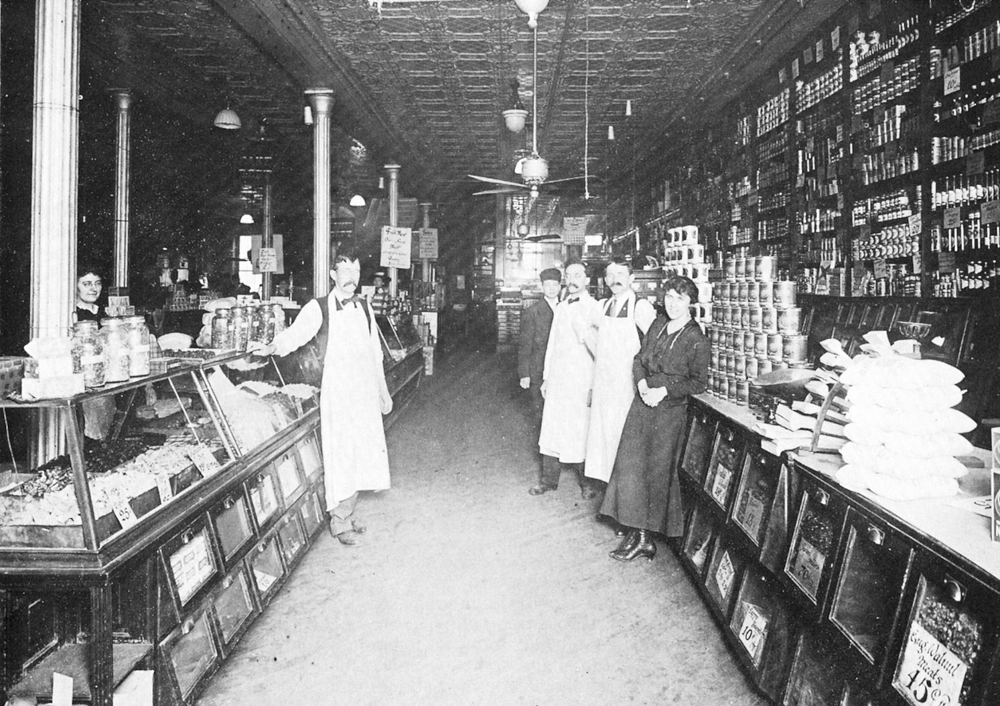
The life we consider “normal” would be utterly astonishing to people living 150 ago. The contrast in how much effort it took in the past to obtain basic goods versus how easy it is now cannot be overstated. I often try to imagine what a time traveler from 1700 or 1800 would feel if I brought them to my supermarker. For most of human history, daily existence was defined by scarcity and toil. Keeping your family fed, clothed, and warm required constant work and careful planning. Food wasn’t something you’d expect to have in dozens of varieties year-round; it was something you grew or bartered for, stored for winter, and hoped wouldn’t run out before the next harvest.
A glimpse of a small grocery store from about a century ago. Even in 1920, stores had limited variety and goods often came in bulk, far from the selection we see in supermarkets today.
To really appreciate how far we’ve come, consider a few then-and-now comparisons that highlight this shift:
Food Variety and Availability: A couple of centuries ago, your diet was limited to what was locally grown or produced. A medieval serf or even a 18th-century farmer ate coarse bread, some root vegetables, maybe occasional meat, and that was about it. Exotic spices or fruits (like a pineapple or cinnamon) were literal treasures, rarer than gold, often reserved for royalty. Fast forward to today – even a budget supermarket has more variety than the grandest royal feast of old. I can buy strawberries in December, shipped from the opposite hemisphere. I can choose rice or pasta or quinoa; chicken or tofu or lentils; spices from India, coffee from Colombia, olive oil from Italy. The average supermarket carries tens of thousands of different items in one place.
Work and Time: Imagine being a peasant in the 1700s – you spend all year plowing, sowing, reaping, and still worry if the harvest will be enough. Perhaps you labor daily just to churn butter, bake bread, salt meats, and preserve what you can for winter. In contrast, I, or any modern person, can work a few hours at my job (whether a teacher, engineer, barista, anything) and with a fraction of a day’s wages fill a cart with a week’s worth of food. It might take me 30 minutes in the store versus months of backbreaking work for the peasant. That time and labor freedom is an incredible wealth we forget we have. I don’t have to grow my own wheat, grind my flour, or cure my meat – it’s all waiting for me neatly packaged. This convenience was unimaginable in the past.
Security and Abundance: In the past, if droughts hit, communities faced famine and possibly extinction. Food insecurity was a constant spectre. Today, thanks to global trade and robust supply chains, a bad harvest in one region is barely felt by consumers elsewhere. The supermarket’s shelves stay full through storms and droughts by drawing on a global network of producers. That peace of mind – not worrying that my family will go hungry because of one bad season – is an enormous form of wealth.
Thinking about these differences fills me with gratitude and frankly awe. We live in a time of bounty that earlier generations, even the richest of them, could hardly imagine. Author Benjamin Lorr aptly described the modern supermarket as “a miracle” that offers “a continuous, dreamlike bounty of products” seemingly without effort.
What makes this system even more fascinating is how invisible its complexity and wealth have become to us. We are so used to convenience that we only really notice when something is missing. The COVID-19 pandemic lives in recent memory. The global dance of trade, transportation, and market competition that fills the supermarket operates quietly in the background of our lives. Farmers in distant countries plant crops talking in languages and dialects we will never hear, factories churn out goods and far away lands, trucks and ships and trains move everything around the globe. All that so that, for a few quid, I can pick almost any ingredient or household item I want. It’s the result of centuries of innovation in agriculture, trade, and economics. In a subtle way, the principles of global trade and free-market enterprise have woven together this cornucopia – oranges from Spain meet salmon from Norway and rice from India, all in one place, because it makes economic sense to trade and stock whatever consumers desire. It’s fair to say that the freedom to trade and the incentives of a market system helped enable this breadth of choice.
Yet for all its magnificence, the supermarket is massively under-appreciated. We don’t typically gush about how lucky we are to have supermarkets – but maybe we should, at least once in a while. We reserve the word “wealth” for mansions or yachts, but real wealth is also having full fridges and cupboards and options to feed your family nutritiously, affordably, and with delight. Real wealth is living without the constant fear of want. By that measure, the average person in a developed country today is incredibly wealthy just by having access to a place like a supermarket. When I can choose between thirty different kinds of cheese, or pick up gigantic fresh blueberries in winter, I am enjoying the kind of abundance that emperors of old would envy.
This perspective has humbled me and made my routine shopping trips feel almost like walking through a museum of progress. I try to remind myself to be amazed. Instead of rushing through the chore, I’ll sometimes deliberately slow down and soak it in: the colours of produce from across the earth, the smells of baked goods and roasted coffee, the fact that all of this is here every day, waiting for us. It fills me with a quiet happiness and respect for the ingenuity and hard work – often by unseen hands – that makes this possible. I think about the farmers, the truck drivers, the store clerks stocking shelves at midnight, the engineers designing refrigeration systems, all contributing to this system that hands me wealth on a silver platter (or rather, a shopping trolley).
In the end, the supermarket is more than just a store – it’s a testament to human progress and cooperation. It stands as a cathedral of abundance where the everyday person can partake in a feast of choices. It represents security against hunger, freedom of choice, and the convenience of time that frees us to pursue other goals in life. This is profoundly positive, and yet we often only see it as ordinary. My goal is not to be sentimental or to gloss over problems (of course there are issues like waste or inequalities, and not everyone in the world has this access), but simply to appreciate the profound good fortune we do have in this system.
In a world so full of abundance, remembering to appreciate it is its own kind of wealth – a richness of perspective. And for me, all it takes is a trip to the supermarket to remind me just how astonishingly wealthy my ordinary life really is.

 3D5G
3D5G 